
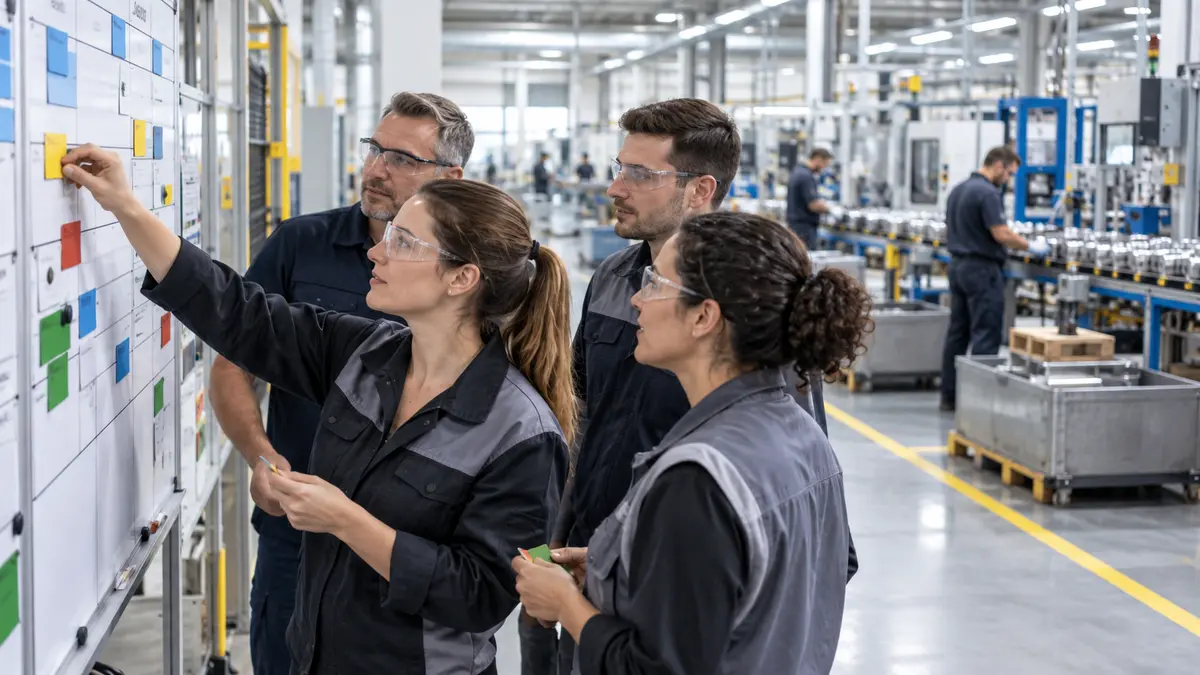
Lean manufacturing improves customer value by reducing waste and creating a more reliable flow of materials and information. It is not a collection of isolated workshops. Sustainable Lean implementation changes how problems are identified, prioritised and managed every day.
Start with value and flow
The first step is to understand demand, the product or service family and the end-to-end process that delivers value. Value-stream analysis can reveal waiting, excess work in progress, unnecessary movement, rework, overproduction and information delays that are difficult to see from departmental KPIs.
The main forms of waste
Common categories include overproduction, waiting, transport, over-processing, inventory, motion and defects. Many organisations also recognise unused human capability. The purpose of these categories is to improve observation and problem definition—not to label every activity without considering its operational context.
Use the right method for the problem
- 5S supports safe, visible and repeatable workplace conditions.
- Standard work creates a stable reference for training and improvement.
- Kanban and pull systems can control replenishment and work in progress.
- SMED separates and improves changeover activities.
- Visual management makes priorities and deviations easier to act on.
- Structured problem solving connects evidence, causes, countermeasures and verification.
Combine Lean with constraint focus
Local waste reduction does not automatically improve the whole production system. Theory of Constraints helps identify the resource, policy or process that limits throughput. Improvement priorities can then protect the constraint, stabilise flow and reduce work in progress and lead time across the system.
Implementation through daily management
Lean becomes sustainable when leaders establish clear standards, short review cycles, visible ownership and disciplined follow-up. Teams should verify whether a change improved safety, quality, delivery, cost or flow before standardising it.
Explore Lean & TOC implementation, Production Consulting & Operational Excellence and REFA & Time Studies. To discuss a practical implementation, start a confidential conversation.

Comments are closed