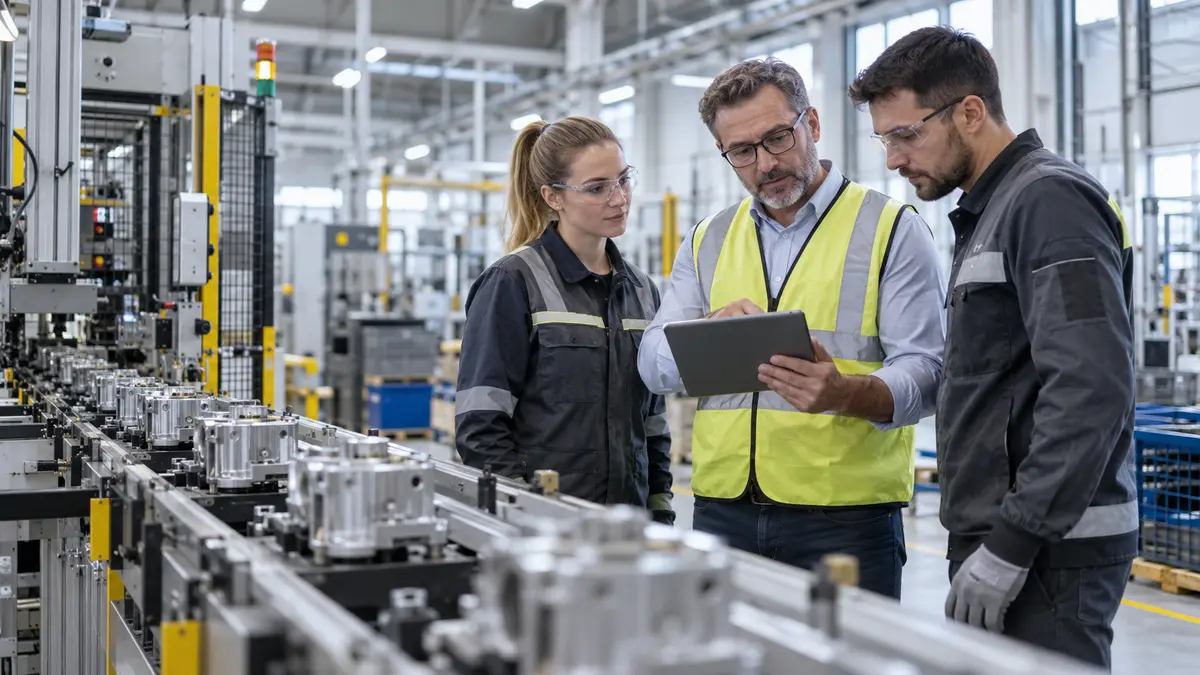
Boosting Overall Equipment Effectiveness (OEE): Strategies for Smarter, More Efficient Manufacturing
In today’s competitive industrial landscape, efficiency isn’t just an advantage — it’s a survival skill.
Manufacturers across Europe are rethinking how they measure and improve productivity.
At the center of this transformation stands Overall Equipment Effectiveness (OEE) — a key performance indicator that bridges the gap between operational goals and real-world performance.
Improving OEE means more than just increasing machine uptime. It’s about understanding the true capacity of your equipment, reducing waste, and creating a culture where every minute on the shop floor adds value.
What is OEE and Why It Matters
Overall Equipment Effectiveness (OEE) is the gold standard for measuring manufacturing productivity. It combines Availability, Performance, and Quality into a single metric that tells you how effectively your equipment is being used.
-
Availability: Measures downtime and equipment readiness.
-
Performance: Tracks how fast production runs compared to its ideal speed.
-
Quality: Reflects how many parts are defect-free.
A perfect OEE score is 100%, meaning production is running without stops, at maximum speed, with zero defects — but in reality, world-class OEE hovers around 85%.
📊 Benchmark:
85% = World-class
60% = Typical manufacturer
40% or less = Significant improvement potential
The Hidden Cost of Poor OEE
Low OEE translates directly into lost profit.
Every minute of unplanned downtime, rework, or reduced speed is money left on the table.
According to the European Manufacturing Performance Index, companies improving OEE by even 10% often achieve 5–7% higher profitability within a year.Common causes of poor OEE include:
Frequent machine stoppages
Inefficient changeovers or setups
Poor maintenance planning
Defects and rework
Lack of standardized work
Proven Strategies to Improve OEE
1. Apply Lean Manufacturing Principles
Start with waste elimination.
Use Value Stream Mapping (VSM) to identify bottlenecks and non-value-adding steps.
Empower teams to run Kaizen events focused on quick, practical improvements — small steps that compound into measurable gains.2. Implement Total Productive Maintenance (TPM)
TPM is the foundation of high OEE.
It promotes ownership at every level — from operators to managers — ensuring machines are reliable, clean, and ready to perform.Key TPM pillars:
Autonomous maintenance by operators
Preventive maintenance schedules
Planned shutdowns for reliability
Root cause analysis (RCA) after failures
👉 Example: One electronics manufacturer in Central Europe improved OEE from 63% to 81% within six months after introducing TPM and visual maintenance boards.
3. Reduce Changeover and Setup Times
Shorter setups mean more uptime.
Techniques like SMED (Single-Minute Exchange of Die) can cut changeover times by 50–70%.
Combine setup standardization with digital checklists or visual aids to make transitions faster and error-free.4. Use Real-Time OEE Monitoring Systems
Modern IIoT (Industrial Internet of Things) tools track downtime, performance, and quality in real time.
These systems help identify loss patterns and visualize the “hidden factory” — where time and resources are lost every shift.Recommended tools:
Tulip – real-time OEE dashboards
Kepware – data collection for manufacturing
MES systems – production monitoring and traceability
5. Train and Engage Your Teams
Technology alone doesn’t improve OEE — people do.
Provide ongoing training for operators and shift leaders on identifying downtime causes, standard work, and problem-solving techniques (8D, 5 Why, PDCA).🧩 Engagement drives accountability.
Operators who understand OEE are 40% more likely to report small stoppages early — before they escalate.The Role of Data in OEE Improvement
Digital transformation in manufacturing has made OEE tracking more accurate and actionable.
By integrating machine data with ERP and MES systems, companies gain full visibility from shop floor to top floor.
Predictive analytics can even anticipate failures before they happen — turning maintenance from reactive to proactive.Sustainability and OEE
Improving OEE isn’t only about profit.
It reduces energy waste, extends equipment life, and supports EU Green Manufacturing initiatives.
Each percentage point of efficiency gained means less material waste and lower CO₂ output — a key step toward sustainable production.Key Takeaways
Improving OEE increases efficiency, reduces costs, and strengthens competitiveness.
Lean and TPM are essential tools for OEE improvement.
Real-time data and team engagement accelerate progress.
Every 1% OEE gain contributes to better sustainability and profitability.
Conclusion
OEE improvement isn’t a one-time project — it’s a mindset.
By aligning people, processes, and technology, manufacturers can turn inefficiency into opportunity.
The journey toward operational excellence starts with one question:
👉 How effective is your equipment — really?

Comments are closed